
Make it useful: giving feedback that sticks
Project overview
This is a self-initiated microlearning project designed to help professionals give clear, actionable feedback in everyday workplace situations. The goal: create a short, behaviour-focused learning experience that supports immediate, on-the-job application.
The module is designed as a standalone learning asset that could be used in internal L&D programs, just-in-time refreshers, or as part of a broader communication skills pathway.
- My role
- End-to-end: analysis, storyboard, visual design, build
- Tools
- Articulate Rise 360, Figma
- Audience
- Time-poor professionals in fast-paced workplaces
- Runtime
- 5 minutes, self-guided, no facilitator
Context
Designed for internal L&D use within a medium-to-large organisation. Key constraints included:
- Learner time limit of roughly 10–15 minutes maximum
- Self-guided, with no facilitator support
- A need for immediate, real-world relevance over conceptual depth
The challenge
Most professionals know that feedback matters, but many struggle to deliver it clearly and constructively in the moment.
Existing training often leans heavily on theory or models, with little time spent practicing real-world judgment. This leads to low knowledge transfer in day-to-day communication.
My approach
Defined a single, observable behaviour outcome
Learners will be able to give specific, actionable feedback in workplace conversations.
Structured a lightweight, high-impact learning flow
Reflection → Concept → Practice → Application. Lightly guided by Gagné’s principles: grab attention, chunk concepts, practice decisions.
Designed for judgment, not recall
- Used scenario-based interactions to help learners distinguish between vague and specific feedback
- Kept visuals and copy minimal to reduce cognitive load and maintain focus on key decision points
This approach draws on my background in UX, particularly designing for decision-making under time pressure and reducing cognitive friction.
Trade-offs & constraints
To maintain a 5–10 minute runtime, I intentionally limited branching depth and focused on high-frequency feedback scenarios rather than edge cases.
Process artifacts
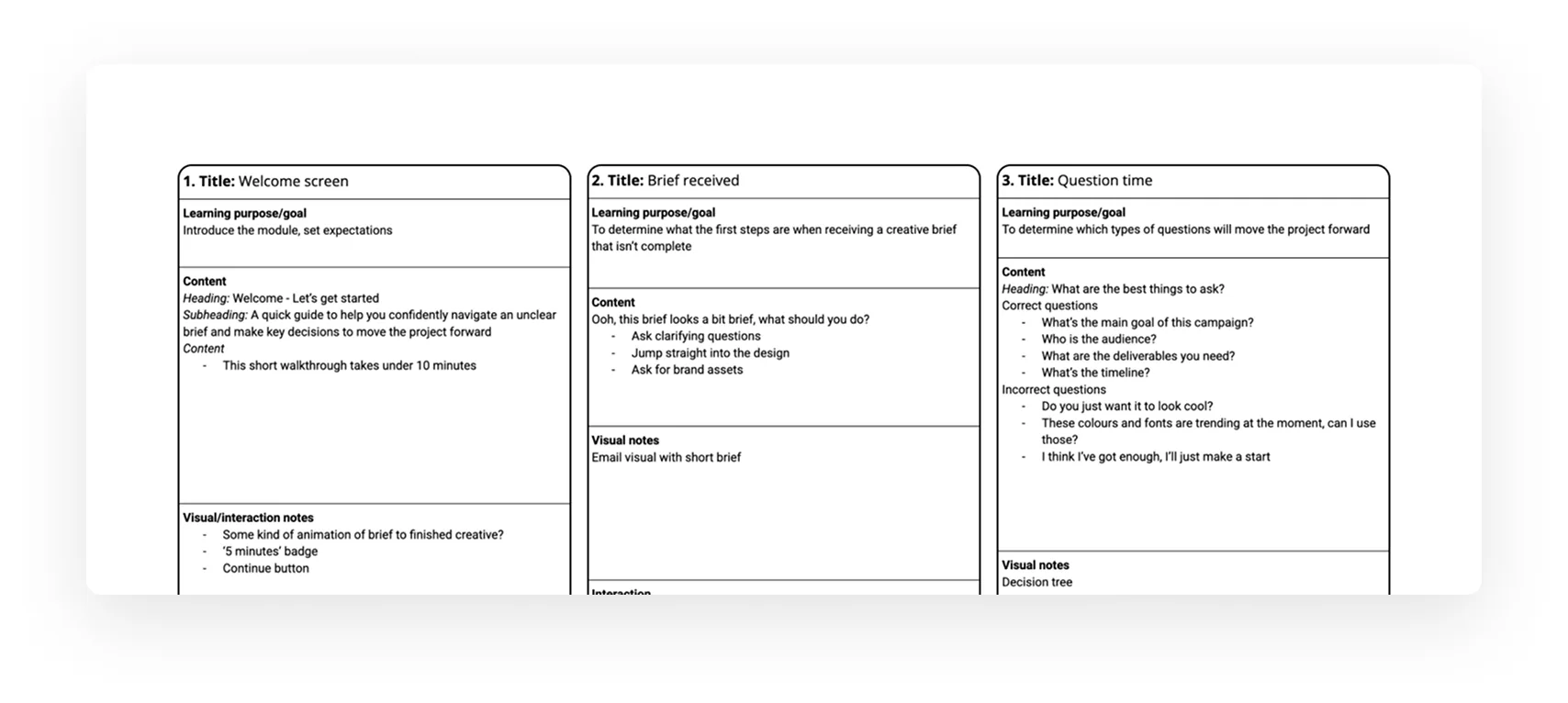
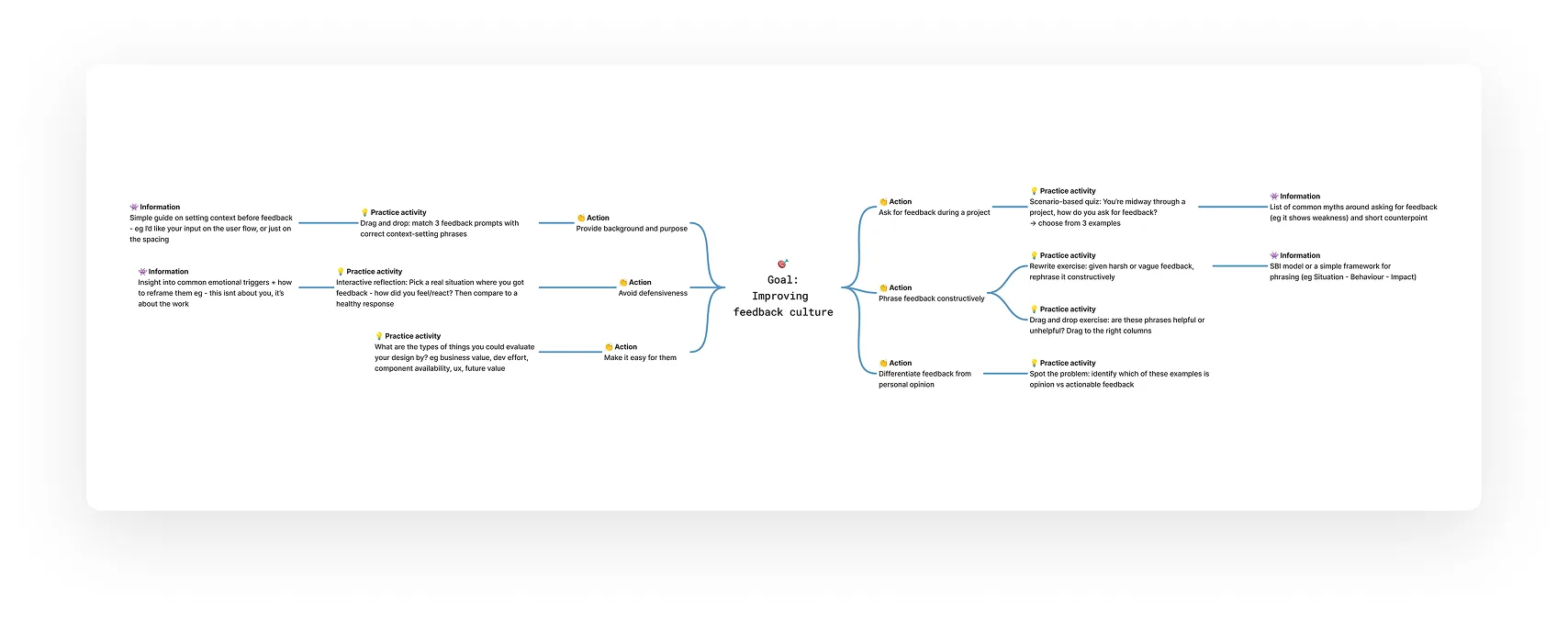
The final design
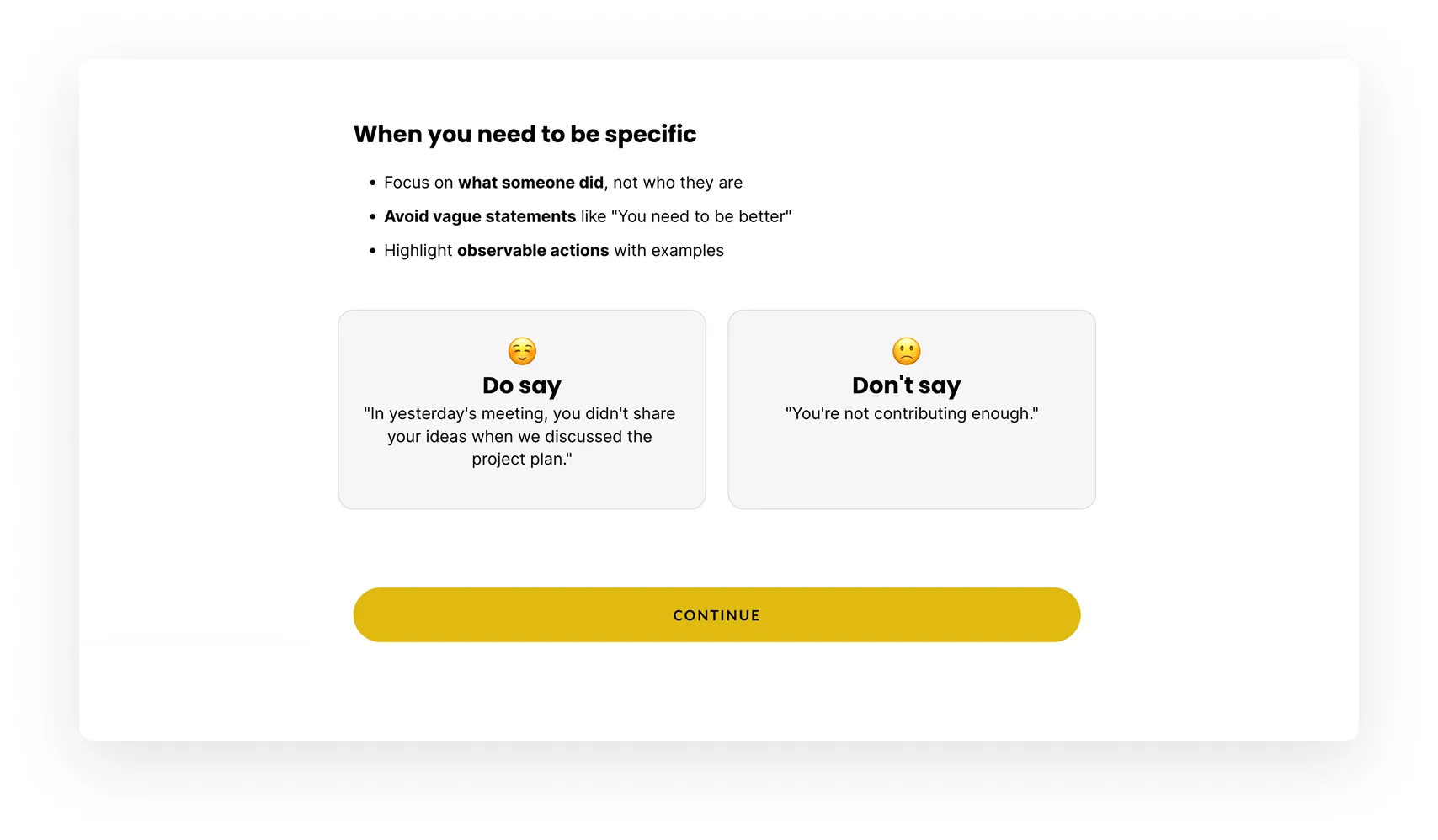
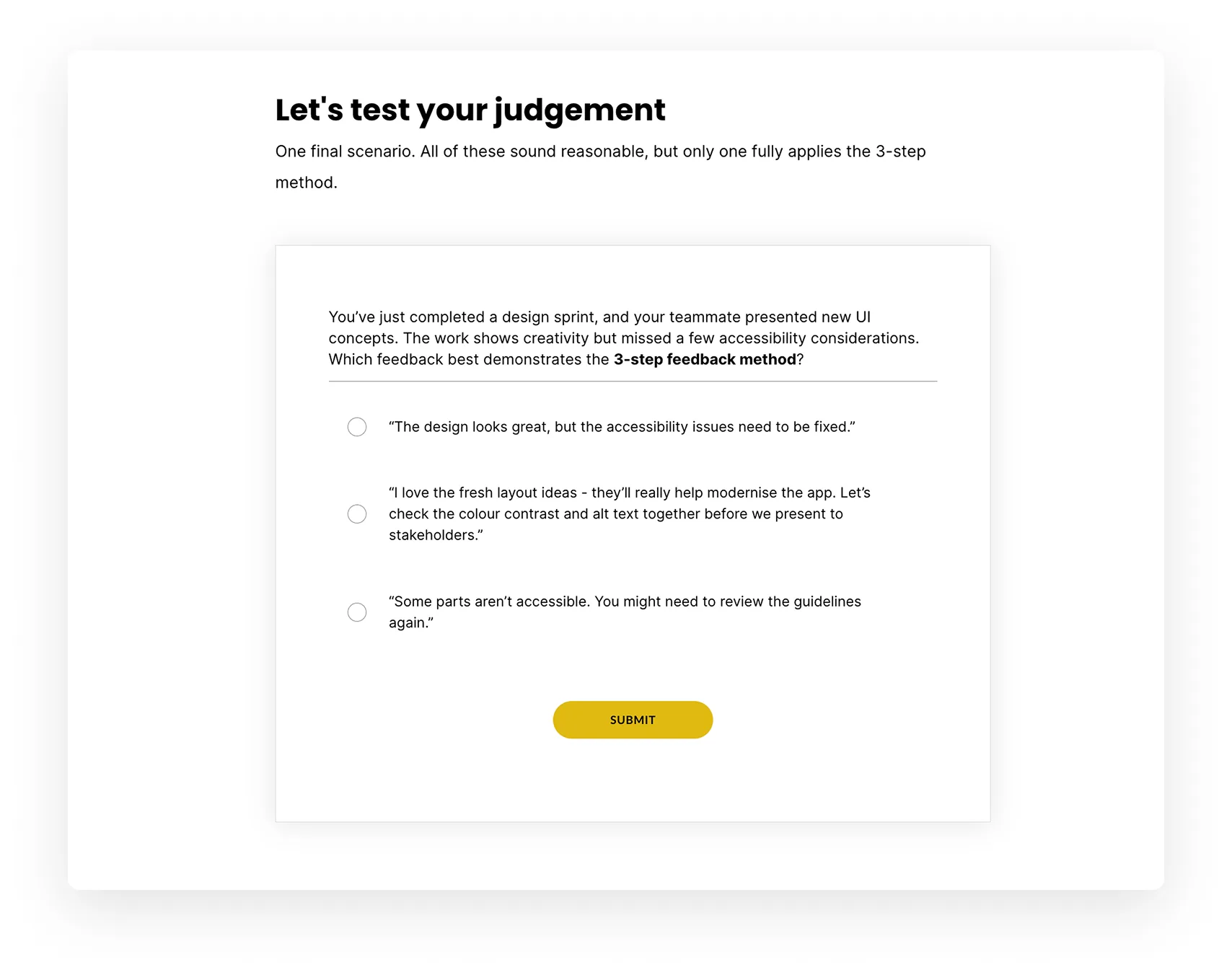
The finished experience is a short, 5-minute module that moves quickly from learner reflection to concept to applied scenario practice.
Key features:
- Scenario-based interactions that reinforce judgment around vague vs. specific feedback
- Realistic decision points aligned with workplace behaviour
- A practical, human tone with no over-explaining or unnecessary content
Outcome
This project demonstrates:
- My ability to translate vague soft-skill goals into clear, observable behaviours
- My use of scenario-based design to support real-world decision-making
- Designing restraint — prioritising what not to include to preserve focus and transfer
The module could be deployed as a just-in-time refresher, part of a broader professional skills program, or standalone support for managers and team leads.
Early peer feedback highlighted the clarity of the flow and the usefulness of the applied scenarios for real conversations.
Reflection
This project helped me refine my skills in:
- Structuring scenario-based microlearning
- Designing for workplace behaviour change
- Balancing brevity with impact in self-paced formats
Next steps
This module could be adapted for different roles (e.g. managers, project leads) or integrated into a broader communication skills learning path.